
The Humanities and the Liberal Arts Core at FSU: A Brief History
The rich tradition of humanities and the broader liberal arts at Florida State University began more than a century ago, preceding the incorporation of the contemporary university itself. From its early days as the Florida Female College and the Florida State College for Women, Florida State University has emphasized the importance of the liberal arts academic model for inspiring and guiding holistic student achievement. Since 1905, Florida State University — in each of its forms — has been at the nation’s forefront in developing modern liberal arts curricula and offering a robust selection of courses and area concentrations from an acclaimed faculty of humanities scholars and teachers. That commitment to the liberal arts and especially to the humanities has resulted, in the 21st century, in FSU ranking as one of the top universities in the U.S. in awarding Ph.D.s in the humanities and fine arts. The founding of the FSU Humanities Center in 2026 accordingly represents the historically deep support for the humanities at FSU and it marks the most recent chapter in FSU’s long history of the pursuit of liberal arts knowledge.
In 1851 the General Assembly of Florida passed “An Act to provide for the establishment of two Seminaries of Learning, one upon the east, the other upon the west side of the Suwannee River.” Tallahassee became the site of the latter institution, which developed in fits and starts through the Civil War and during the turbulent postwar period. By the 1890s, it had become recognizably collegiate and for a brief time at the beginning of the 20th century was called Florida State College. In 1905, Florida governor Napoleon Bonaparte Broward signed into law House Bill No. 361 — known as the “Buckman Bill” for its author, Henry Buckman. The bill, Broward hoped, would serve to alleviate the “duplication of services, acrimonious rivalries, and expensive competition” that had come to characterize Florida’s state education system. By 1905, eight higher-education institutions were competing for state funding, often submitting inflated budget requests as they jockeyed for appropriations. Consequently, under the Buckman Bill, all existing state educational institutions were to be eliminated and replaced by four new ones: the Florida Normal and Industrial College for Negroes, now Florida Agricultural and Mechanical University in Tallahassee; the Institute for the Blind, Deaf, and Dumb, now the Florida School for the Deaf and Blind in St. Augustine; the University of the State of Florida, now the University of Florida in Gainesville; and the Florida Female College, or FFC, located in Tallahassee.
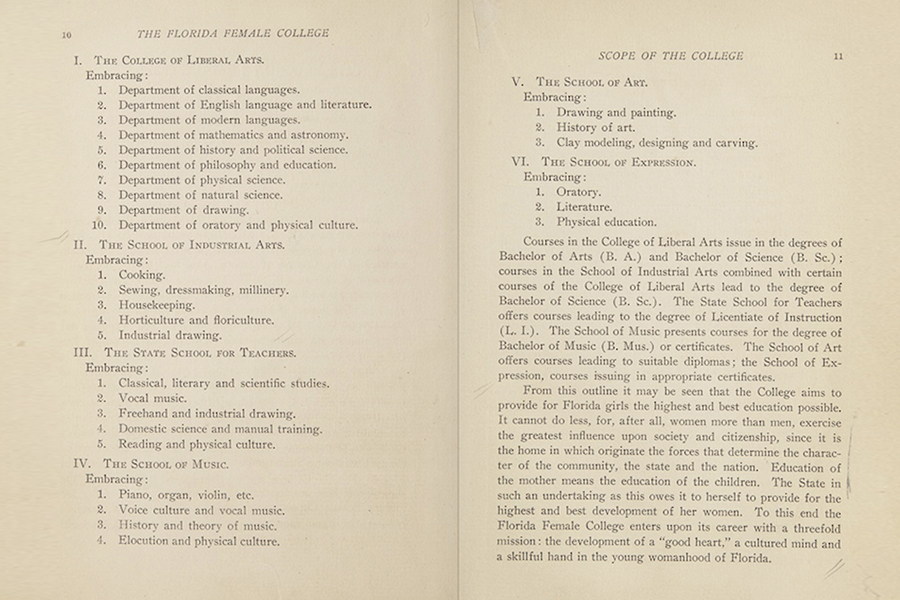
At the time, it was not unusual for a state to fund an institution devoted to women’s higher education. During the 19th century, many southern states had prohibited female students from attending land-grant or private universities, preferring instead to found a series of state-funded colleges devoted exclusively to the education and vocational training of (White) women. What was unusual about FFC, however, was its curriculum. Unlike comparable women’s colleges in Alabama, the Carolinas, Georgia, Mississippi and Texas, Florida Female College did not function primarily as vocational school for teachers. Known as “normal schools,” vocational institutions provided training and certification for teaching in the K-12 public school system and comprised the majority of women’s colleges — especially in the turn-of-the-century American South. By contrast, FFC’s first president, Albert Alexander Murphree, emphasized a liberal studies approach. At its opening in September 1905, FFC boasted departments of English, modern languages, ancient languages, philosophy, history, elocution, political science, music, art and physical culture. In a general curriculum supplemented by courses in mathematics and science, those departments served as the bedrock for the liberal arts at FFC, and on that foundation the institution built out a dynamic university curriculum over the next century. Undergraduates in 1905 could choose from several programs of study and, while students could still obtain a Licentiate of Instructure from FFC’s in-house normal school, which later combined with the Florida State School for Teachers, most students pursued a bachelor’s degree in liberal arts, industrial arts, the School of Music, the School of Art, or the School of Expression. As such, the Florida Female College marked the first southern women’s institution to consider liberal arts education its primary focus.
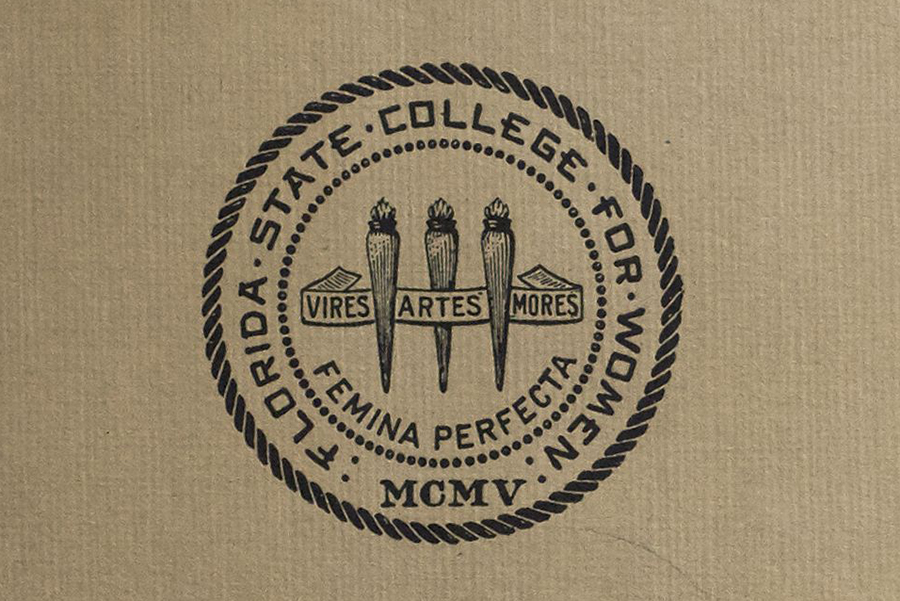
In 1909, a grammatical dust-up ushered in the next era for FFC. Objecting to the institution’s name on the grounds that “Florida Female College” erroneously implied the gender of the college itself, legislators and university affiliates moved to rechristen the school as “Florida State College for Women" since “the best English usage is opposed to the present title.” The motion passed and, a year later in 1910, FSCW debuted a new seal to accompany its new name. Art student Agnes Granberry’s design featured the now-iconic three torches “with a banner woven through them at midsection. The words Vires, Artes, Mores (strength, skill, customs) imposed upon the banner defined the triple purpose of the college — to educate the student physically, mentally, and morally, and thus produce Femina Perfecta, the completed woman.” The holistic approach to higher education represented in the new motto would guide FSCW’s liberal arts-centered approach into the 21st century. From the beginning, then, FSCW was not to be a vocational school. In recognizing the enmeshment of vires, artes, and mores, the FSCW aimed at educating the whole person, for the purpose of making her an informed and thoughtful citizen, a strong contributor to discussion and debate about the challenges facing a rapidly growing nation, and an actor equipped to lead through those changes.
From the beginning, student life at FSCW consisted of interconnected formal and informal programs that were considered mutually reinforcing means for the education of the whole person. Students cultivated vires through a vibrant intramural sports rivalry between two on-campus basketball teams that formed organically among the student body in 1906. The “Cockleburs” and the “Prickly Pears,” as the teams were called, clashed annually around the Thanksgiving holiday. They were later renamed twice. A first rebrand in 1907 changed the contest into “Stars” versus “Crescents"; again in 1915, the teams were formally reorganized into “Odds” and “Evens,” referring to the graduation years of the players. The Odd/Even rivalry would continue as the primary source of student spirit and competition in FSCW campus life, expanding beyond the basketball court into leadership societies, theatrical productions and other athletic events.
Similarly, FSCW instilled mores in its students through a program of activities, some voluntary, others compulsory, intended to familiarize girls with the social responsibilities — and for Southern women, a distinct pattern of social graces — of early-to mid-20th century American life. A mandatory chapel service was held at 8:40 a.m. each weekday morning during which girls received morality lessons; attendance at church was also required on Sunday morning. Mrs. Mary Reynolds, who oversaw student life as Lady Principal of the dormitories, hosted Monday evening “at homes,” during which girls received both refreshments and instruction in subjects such as table manners, social decorum, dress, etc. So important was the development and protection of the girls’ character that, when the local farmers’ markets gathered at the corner of Adams and Jefferson streets on Saturdays, FSCW insisted on holding Saturday classes, lest the students leave campus to mingle with the farmhands and laborers who were deemed unsuitable by then-president Edward Conradi. In exchange, no classes were held on Mondays, and downtown storefronts soon advertised Monday specials to entice FSCW students on “the college girls’ day off.”
And yet, Femina Perfecta could not be achieved without dedication to the artes. Under the auspices of President A. A. Murphree, FSCW gained a reputation for approaching the liberal arts and humanities with an academic rigor that surpassed other institutions: applicants to FSCW were required to have a year of Greek or modern language — something the men’s university in Gainesville did not require. Florida State College for Women also expected its applicants to have a greater command of Latin and history than did its Gainesville counterpart, as Murphree expected a Bachelor of Arts degree from FSCW to be sufficient for graduate level work at the elite women’s institutions of the day, such as Vassar, Smith and Wellesley. Outside of the classroom, too, FSCW’s liberal studies curriculum encouraged students to hone their writing abilities and their creative sensibilities through involvement in student publications such as The Talisman (1906) annual, or the Flastacowo yearbook, the name of which functioned as an acronym for “Florida State College for Women.” The Florida Flambeau student newspaper, first published in January of 1915 and still running today in conjunction with FSView, enjoyed an especially close relationship with the humanities. Humanities faculty proofread issues of the Flambeau before they went to print — and none with more attention than William G. Dodd, head of the Department of English and dean of Arts and Sciences, who scrutinized each draft with an English professor’s eye for prose.
It was not long before FSCW’s pioneering approach to women’s education garnered national recognition. During the 1922-1923 academic year, FSCW reorganized its scholastic divisions, formally establishing a College of Arts and Sciences in addition to the schools of education, art, expression, music, home economics, business, summer school and the extension service. In 1924, the Association of American Universities placed FSCW on its list of approved colleges and universities, making Florida State College for Women the first tax-supported women’s college in the U.S. to receive such accreditation. Over the next three years from 1924-1926, the newly established College of Arts and Sciences separated into standalone departments several programs that had been jointly housed. In particular, the Department of History, chaired by the venerable Arthur “Pi” Williams, was separated from the political science program and rehoused in what is now called the Williams Building in his honor.
Eccentric and beloved by students, Williams was one of the most recognizable faces among a humanities faculty that, compared to FSCW’s rotating cast of industrial professors, changed little for the first three decades of FSCW academic life. Though he began his career in the history department, Williams would serve as vice president of the college from 1913 until his retirement in 1937. Teaching alongside his sister, Rowena Longmire, for whom the Longmire Alumni Building is named, Williams quickly became a constant figure in FSCW life outside the classroom, too: Williams and Longmire were known as perpetual supporters of the Evens in the annual Thanksgiving basketball game, and Williams sometimes served as the team’s unofficial coach. By 1928, the College of Arts and Sciences offered two courses in Bible and religious education — taught by Williams and by veteran classics professor, J. B. Game. Williams spearheaded FSCW’s biblical history and ancient Mediterranean literature studies, presaging the founding the Department of Religion in 1965, and the ascent of area emphases in classics and history.
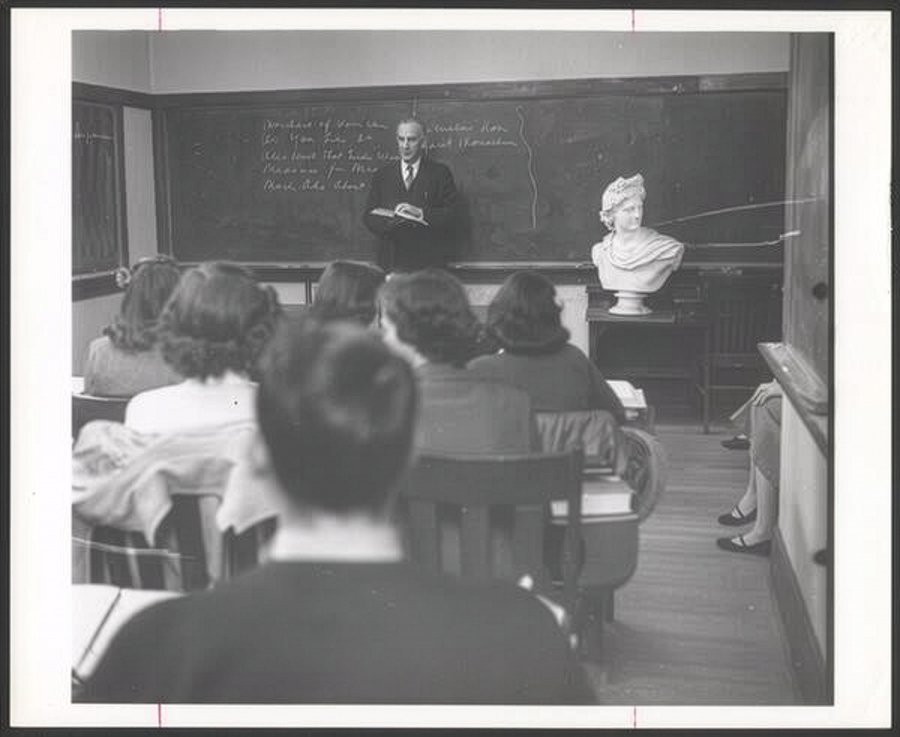
The real powerhouse behind FSCW’s academic success, however, was William G. Dodd. Hired in 1910 to serve as chair of the English department, Dodd became dean of the College of Arts and Sciences in 1913, in which capacity he guided FSCW’s academic direction until his retirement in 1944. Called the “Prime Minister of the Deans,” it was Dodd who modernized FSCW’s liberal arts curriculum and propelled it to national recognition. In the mid-1930s, Dodd inaugurated majors in both art and speech, making his College of Arts and Sciences one of the first in the nation to do so. In the fall of 1936, Dodd introduced the “integrated courses” model — a common core curriculum for freshmen and sophomores in the humanities, social studies or social sciences, physical sciences and biological sciences. An ardent believer in the FSCW’s liberal humanities and sciences approach, Dodd maintained that “no matter what vocation or profession a student may engage in after leaving college, she serves society in her chosen activity all the better for being the improved ‘person’ she may be through the pursuit of liberal knowledge.” When the new library was built on campus in 1956, the old FSCW library was renamed Dodd Hall. It currently houses the departments of religion, classics and philosophy.
The FSCW faculty included a number of other memorable characters who contributed in various ways to the early advancement of the humanities at FSU. Classics professor J. B. Game, who taught from 1914 until his death in 1935, fostered physical culture alongside study of the cultures of the ancients by encouraging students and faculty alike to roam in “Game’s Woods”— a few acres of land he purchased for campus recreation. In 1922, the English department hired a dashing associate professor whose tennis playing would cause “the track gym class [to form] a line of admiring spectators.” Thirty-four years later, that associate professor — a scholar of Shakespeare named William Hudson Rogers — would be named the first distinguished professor in Florida State University’s history. Rogers Hall bears his name. In 1924, Olivia N. Dorman joined Game in the classics department. In addition to teaching Latin and Greek, she assumed the role of dean of students, becoming a favorite as she implemented a series of campus life reforms: dancing on Friday and Saturday nights, smoking in private rooms, and leaving campus by car, even with men, were all permitted for the first time during Dorman’s tenure.
Florida State College for Women’s rising reputation for academic excellence was accomplished even though the cost of attendance was a fraction of what comparable institutions charged. In September 1934, FSCW and the Connecticut College for Women became the first women’s colleges in the U.S. to be granted chapters of the Phi Beta Kappa honor society. By the fall of 1938, enrollment hit a record of 1,850 students, making FSCW the second largest American women’s college. New Deal legislation following the Great Depression not only grew the ranks of faculty and staff but allowed FSCW to revive its previously postponed on-campus renovations and new constructions.
As the university grew, it changed. After the Second World War and the introduction of the GI Bill, the number of men applying to colleges and universities rose sharply, exceeding the enrollment capacity of men’s institutions like the University of Florida in Gainesville. By the summer of 1946, male students began applying to FSCW, in spite of the fact that their enrollment still was prohibited. Seeking to circumvent the issue, in September of 1946 the governor of Florida created the Tallahassee Branch of the University of Florida, or TBUF. This measure allowed roughly 1,000 male students to use FSCW facilities without technically enrolling as FSCW students. Though they were housed offsite, the campus became all but co-educational, and its future seemingly inevitable. On May 15, 1947, Governor Millard Caldwell signed an act to formally incorporate FSCW and TBUF as a single state-funded university, open to white male as well as white female students. Florida State University was born.
The commitment to the liberal arts that made the Florida Female College a national leader in women’s education guided the development of Florida State University, and the humanities remained the core of that curriculum. The humanities, as they developed over the next 80 years, coalesced in the form of departments of art history, classics, English, history, modern languages and linguistics, musicology, philosophy and religion. Some other departments with social scientific leanings became closely affiliated with those distinct humanities area departments in a spirit of interdisciplinary conversation and exchange. As they grew, each of the humanities departments developed its own characteristic research and teaching agendas and located itself within the university in distinctive ways.
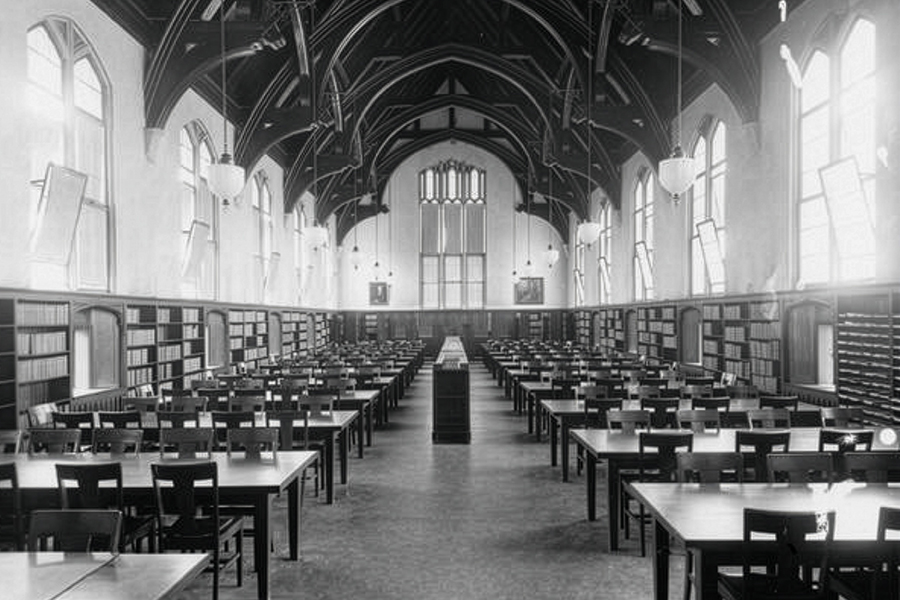
The various humanities departments at FSU developed what today are their distinctive strengths and emphases over the course of the second half of the 20th century. In some cases, that meant new, independent programs arose from previously existing departments or schools. And when they did, they sometimes developed in ways that reached well beyond Tallahassee, as FSU became one of the nation’s top schools for study abroad — ranking fifth in the nation in a 2023 Open Doors report — with campuses in London, Florence, Valencia and Panama, all grounded in a humanities curriculum.
When the Florida Female College opened its doors in 1905, the School of Art numbered among its six original programs of study. Over the next six decades, students enrolled in art history courses on campus and attended seminars hosted at the Ringling Museum of Art in Sarasota, until 1979, when the Department of Art History formally separated from the Department of Art to pursue an intellectual and teaching agenda that brought it more clearly into the circle of the humanities. Within two years, under chair Patricia Rose, that transition was signaled by publication of the first issue of Athanor, which became an internationally distributed journal of graduate student papers that remains today a lively outlet for debate of ideas and discovery of new frontiers. Art history at FSU then turned its sights beyond Tallahassee, establishing international undergraduate programs as well as an international teaching appointment in Italy for doctoral students. Such ventures ensured that it remained in close conversation with other humanities departments at FSU, some of which — such as classics, English, and modern languages and linguistics — also developed strong overseas programs.
Similarly, in 1965, Florida State University divided its Department of Philosophy and Religious Studies into two standalone departments. In the years since, those departments have assembled faculties that provide exceptional coverage of their fields. Both have built strong graduate programs alongside their undergraduate curricula, and both have become the homes to leading journals in their fields. The Department of Religion, which Niche ranks as the #4 religious studies program among public universities nationally, works closely not only with the philosophy department but with the departments of classics and history in interdisciplinary projects and teaching initiatives. It offers courses bearing on religion in every part of the globe and across three millennia and attracts M.A. and Ph.D. students from around the world. In addition to the religion major, it offers a joint major in religion and classics, as well as a human rights and social justice major. The Department of Philosophy, also with a lively graduate program, has been recognized by the Philosophical Gourmet Report as being the top-ranked graduate program in the philosophy of action in the English-speaking world. The popular Werkmeister Humanities Reading Room, located in Dodd Hall, is named after William H. “Werkie” Werkmeister, a Kant scholar who served in the department from 1966 until the early 1990s.
The Department of Classics at Florida State University is the oldest classical studies department in Florida and one of the largest classical studies programs among U.S. public universities. Offering programs in classical philology, ancient history, and classical archaeology, the Department of Classics reinforced the previous emphases on Greek and Latin and ancient literature through the leadership of faculty such as Lynette Thompson, who taught at both Florida State College for Women and Florida State University from 1942 until 1994, one of the longest tenures of any FSU faculty. The Department of English at Florida State University, ranked by Niche in 2026 as #8 among public universities, has extended “English Studies” to its most critical parameters by bringing together history, theory, textuality, and materiality in exploration of how humans communicate within and across their creative environments. Alongside a rigorous curriculum in literary studies, the department offers a distinctive, professionally-oriented undergraduate major in editing, writing, and media, preparing students for careers in journalism, publishing, digital media and communication. Building on a literary tradition that reaches back to the Florida State College for Women, the department developed a creative writing program whose MFA and Ph.D. degrees rank among the strongest in the country. At the graduate level, the department also offers master's and doctoral degrees in literature, media, and culture and in rhetoric and composition, training scholars and teachers across the full range of the discipline.
The growth of the Department of Modern Languages and Linguistics at Florida State University over the last century again evidences the extent to which an international emphasis became central to an education in the humanities at FSU. Now one of the largest humanities units at FSU, the department offers programs in linguistics and in language and literature study in Arabic, Chinese, French, German, Hebrew, Italian, Japanese, Slavic and Spanish. In addition to robust study abroad options at FSU’s overseas centers, students can join like-minded classmates in Tallahassee in residential language houses. The Winthrop-King Institute for Contemporary French and Francophone Studies, recognized as a leader in global French studies, similarly fosters interdisciplinary research by hosting conferences and writers-in-residence, and supporting students through scholarships and summer abroad opportunities. The first of its kind in Florida, the Middle East Center runs outreach programs and sustains a degree in Middle Eastern studies.
The School of Music also dates its founding to Florida Female College’s original six programs of study. Now housed under Florida State University’s College of Music — the third largest university-based music program in the United States — musicology students enjoy access to the Warren D. Allen music library, an 18,000-square-foot archive that is the most comprehensive of its kind in the American Southeast, as well as the largest transcultural, transhistorical collection of musical instruments in the American Southeast. Scholar-musicians in the Musicology Program merge research with musical performance in a wide variety of ensembles, including Advanced Intercultural, Balinese Gamelan, Brazilian, Chinese, CMA/Rainbow Concert, Mas ‘n Steel, Modern Pop, Old Time and Early Music. They pursue research across a wide range of regional and chronological settings, sometimes in collaboration with other departments, such as religion and history. Meanwhile, students in the Music Theory Program pioneer paradigms for analyzing 500+ years of music from around the world, including jazz, musical theater, rock and pop, and video game music. Working across these styles, they explore music’s relationship with aesthetics, intellectual history, mathematical/computational approaches, gender studies, media studies, pedagogy and psychology.
The Department of History, ranked by Niche as #11 nationally among public universities, offers courses covering many parts of the world and across many timelines. It is the home of the Institute on Napoleon and the French Revolution — the premier center for Napoleonic Studies in North America — and hosts the Institute of World War II and the Human Experience, one of the largest non-federally funded repositories of World War II archival materials in the U.S. As is the case in other humanities departments, a relatively high percentage of those who complete its undergraduate program go on to disciplinary graduate work, to law school, or to other professional training.
The Theatre and Performance Research Program brings together artistic practice and humanistic inquiry through the study of theatre and performance as historical, cultural, aesthetic, and embodied forms. Faculty and students pursue research across theatre history, dramatic literature, critical and performance theory, dramaturgy, directing, design, and performance, with particular emphasis on the productive intersections of scholarship and creative practice. The Ph.D. program in Theatre and Performance Research fosters artist-scholars whose work moves between traditional humanities research and practice-based modes of inquiry.
At this moment of the founding of the FSU Humanities Center in 2026, the humanities at FSU has taken an important step forward at the same time that it remembers its deep roots in the liberal arts tradition of the institution. With a long history and a record of constant innovation, the humanities at FSU offers an exceptionally broad range of areas of study, numerous opportunities to explore internationally, and a lively intellectual culture in which students frequently conduct research together with faculty and learn to cultivate disciplinary expertise while experimenting with interdisciplinary ventures. The humanities at FSU carry forward the commitment of those who built the university’s foundations and coalesced an ambitious vision of its future. Referring to the emergence of FSU in the 1940s, historian of the university Robin Jeanne Sellers observed that Florida State College for Women’s “well-established, nationally recognized liberal arts program formed the institutional core of the new university.” That core commitment to the liberal arts — a program of critical analysis, humanistic reflection and interdisciplinary collaboration — frames the mission of the FSU Humanities Center and inspires its dedication to fostering intellectual community, scholarly achievement, and the creative and energetic teaching of the humanities. It was Dodd’s tireless passion for “the pursuit of liberal knowledge” that made Florida State College for Women a bastion of the humanities a century ago. The FSU Humanities Center now extends that passion into the 21st century.